
Multi-platform Integrations
WhatsApp Integration
Connect your WhatsApp number to Chat Data and your AI agent answers your customers on WhatsApp, day and night, while you keep the WhatsApp Business app on your phone. You and your AI agent share the same number: jump into any conversation from your phone or from Chat Data Live Chat, and the AI steps back while you talk.
This guide walks you through it: put your number on the WhatsApp Business app, connect it to Chat Data, then reach customers first with WhatsApp templates and campaigns.
Before you start
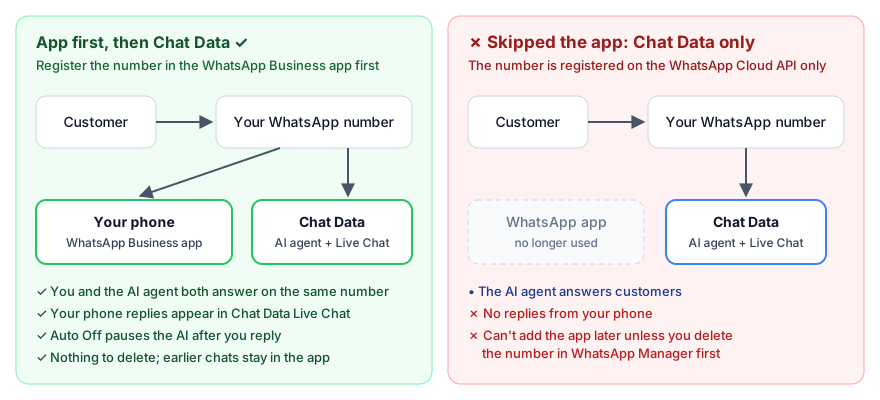
Put your number on the WhatsApp Business app first, then connect it to Chat Data. Done in this order, your number works in both places: your AI agent answers customers in Chat Data, and you can still read and reply from the WhatsApp Business app on your phone. Your phone replies show up in Chat Data, and the AI steps back while you talk.
Do this first, or you can't add the app later
If you connect a number that isn't on the WhatsApp Business app, WhatsApp registers it for Chat Data only (on the WhatsApp Cloud API). A number registered this way can't be used in the WhatsApp or WhatsApp Business app. To use it in the app again, you have to delete it from your WhatsApp Business account in Meta first, and then connect it again (see Connected without the app by mistake).
Check these before you connect:
- Turn on live chat in Settings > Live Chat (it's off by default), so the Live Chats inbox updates as customers write and you get email alerts when you're away.
- Update the WhatsApp Business app to version 2.24.17 or later, and keep your phone nearby: you'll scan a QR code with it during setup.
- The number must be registered in the WhatsApp Business app. If it isn't yet, first follow Set up a new number in the WhatsApp Business app.
- A number on the regular WhatsApp app (not WhatsApp Business) must first move to the WhatsApp Business app. When you register the number in the WhatsApp Business app, it offers to bring over your account and chats.
- Once connected, WhatsApp changes a few app features: linked devices are disconnected and need to be linked again (WhatsApp for Windows and WearOS are not supported), broadcast lists become read-only, and disappearing messages, view once and live location are turned off for one-to-one chats. Group chats, calls and your business tools are unchanged.
- Keep the app on your phone and open it at least once every 13 days. If the app isn't used for about 14 days, WhatsApp disconnects the number from Chat Data and your AI agent stops receiving its messages. To fix it, follow Connect WhatsApp with Chat Data again.
- Campaigns from a number that is also on the app send at up to 20 messages per second (Meta's cap for these numbers). WhatsApp also doesn't offer its verified (Official Business Account) badge for these numbers.
- Your earlier chats stay in the app. Chat Data does not import them; it starts from the next message.
Set up a new number in the WhatsApp Business app
If your number isn't on the WhatsApp Business app yet (for example, a new number for your business), set it up there before you connect it to Chat Data:
- Install the WhatsApp Business app from the App Store or Google Play on a phone your team keeps.
- Register your number in the app and verify it with the code WhatsApp sends by SMS or phone call. A landline works too: choose to receive the code by call.
- Add your business name and profile.
- Connect the number as described in Connect WhatsApp with Chat Data below.
WhatsApp may not accept a number that is brand new to the app straight away. If Meta's window says more activity in the WhatsApp Business app is needed, use the number in the app for real conversations for a few days and try again. Don't connect it without the app in the meantime.
Connect WhatsApp with Chat Data
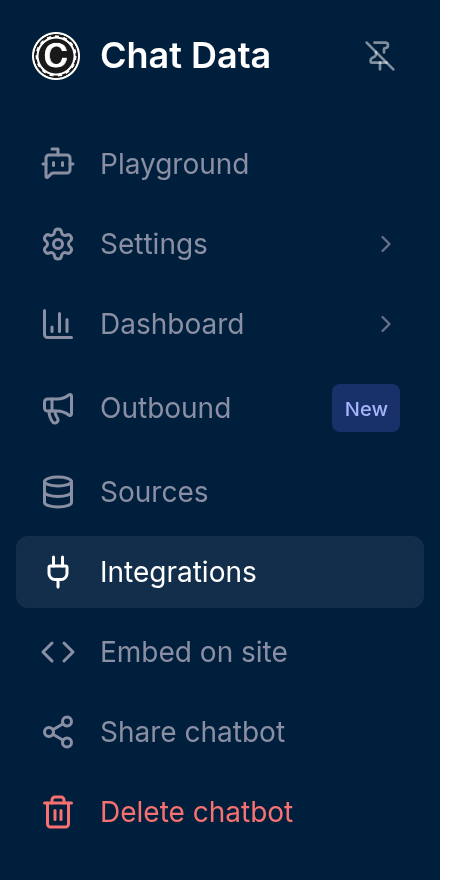
Open your chatbot and select Integrations in its left-hand menu (hover over the menu to see the names).
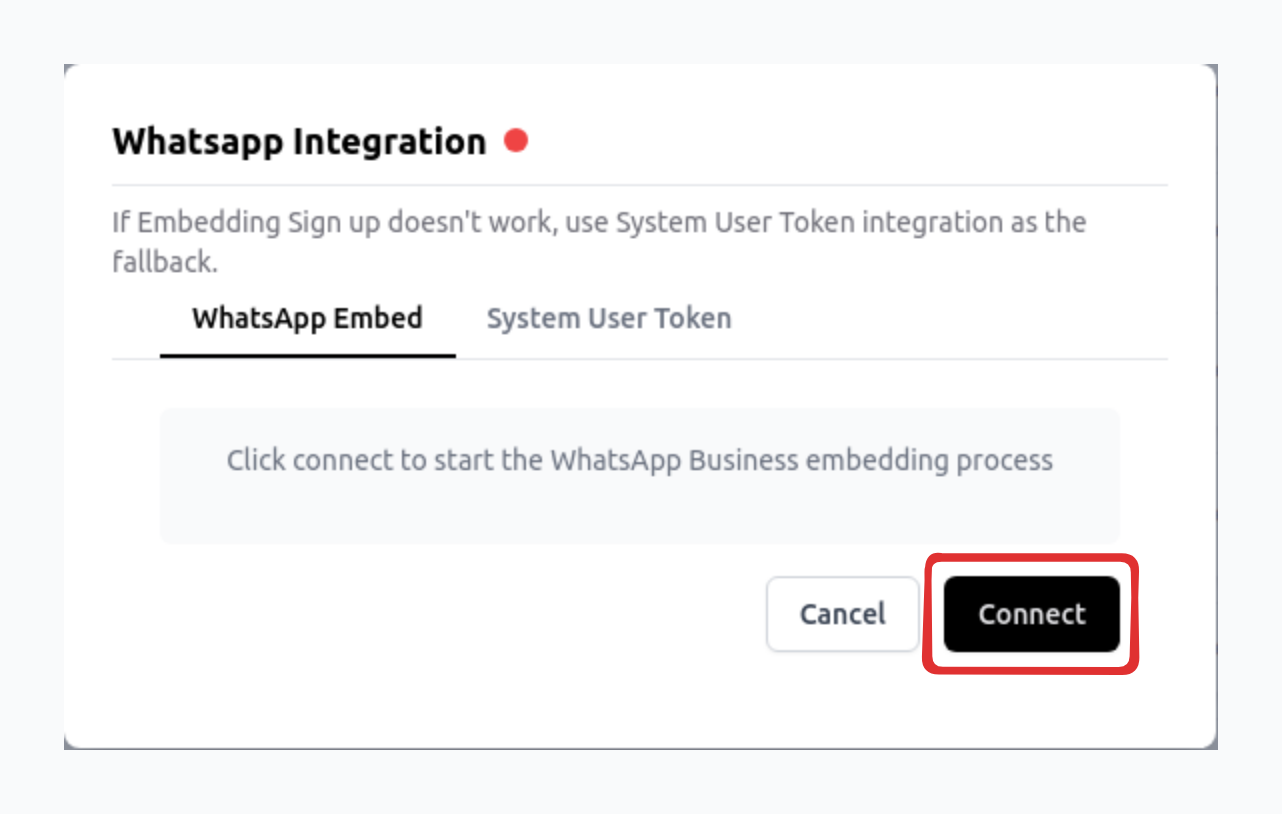
Select the WhatsApp integration card.
Click the Connect button in the pop-up window. (The pop-up also mentions a System User Token fallback; only use it if this signup keeps failing, and read the warning in System User Access Token Signup Process first.)
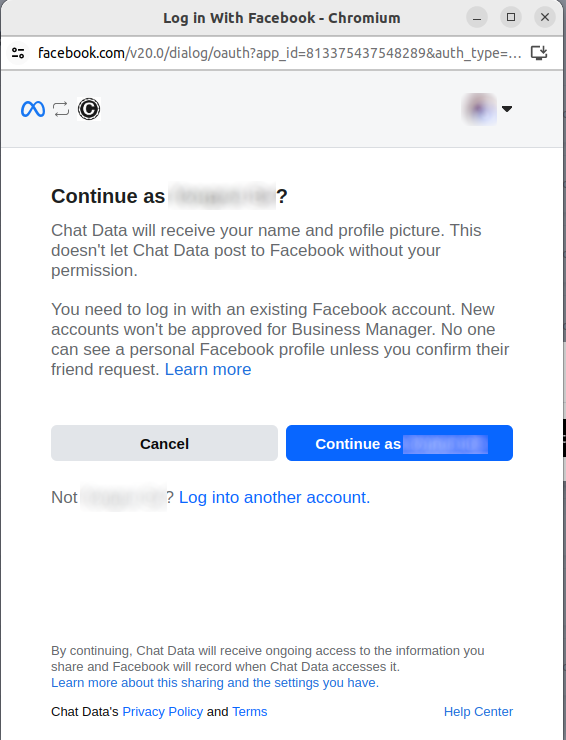
Sign in with your personal Facebook account.
Press Get started.
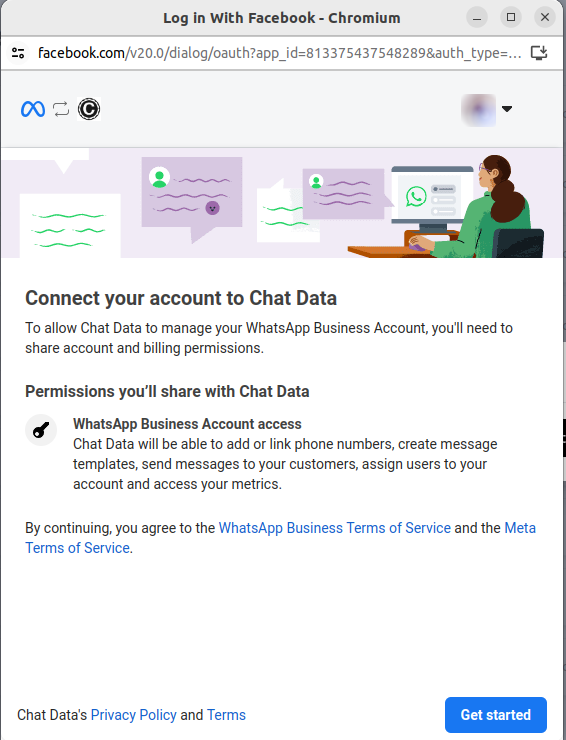
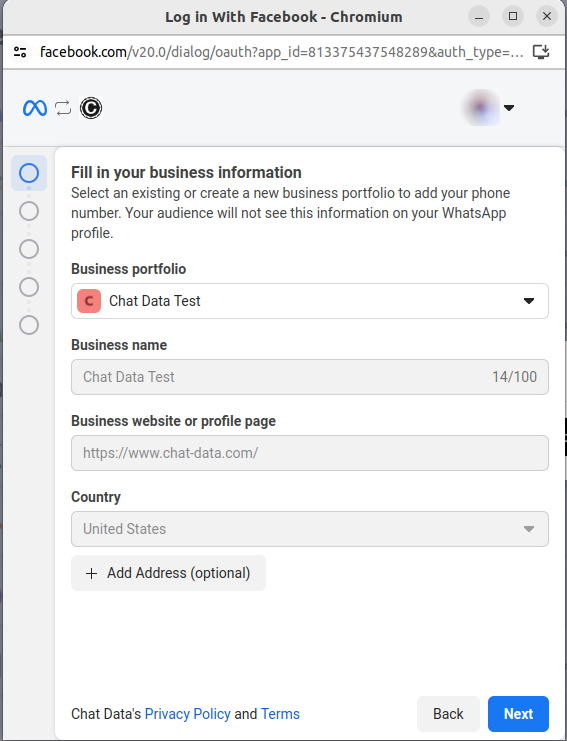
Choose or create your Meta business portfolio (your company in Meta). If you create one, fill in your business name, website and country. Creating one here is fine; it's different from the WhatsApp Business profile in step 7.
Enter the phone number that is on your WhatsApp Business app. Meta recognises it and continues with connecting your app. If Meta instead asks how you want to connect, choose to connect your existing WhatsApp Business app and enter the number.
Don't create a new WhatsApp Business profile
Don't choose Create a new WhatsApp Business profile or add your number as a new phone number, and don't delete your WhatsApp account if Meta asks. That connects the number without the app: your phone chats are lost and you can no longer reply from your phone. See Connected without the app by mistake.
Meta shows a QR code. Open the WhatsApp Business app on your phone and scan it. (If Meta shows a verification code instead, follow the instructions in the window to enter it.)
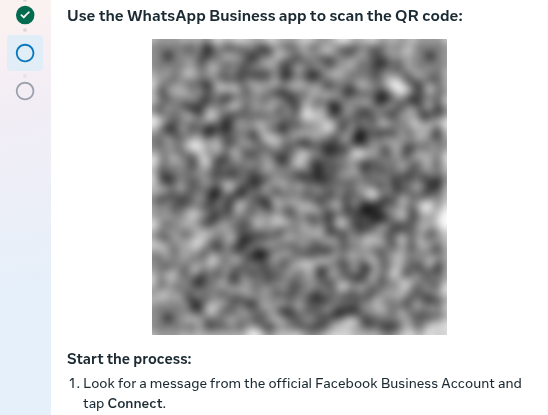
On your phone, open the message from the official Facebook Business account and tap Connect. If you don't see it, go to Settings > Account > Business Platform in the app.
Tap Connect to the Business Platform, then Confirm.
If the app asks whether to share your chat history, either choice is fine: Chat Data does not import earlier chats.
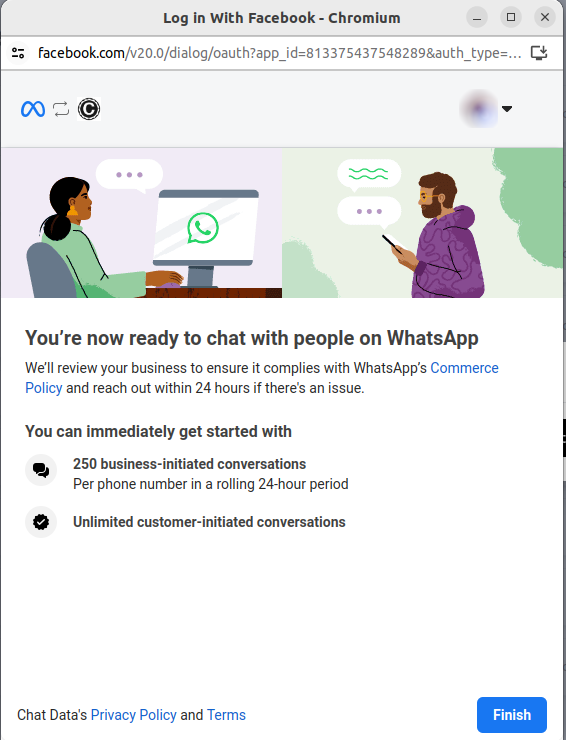
Back in the Meta window, click Next or Continue through the remaining screens (keep the defaults) until you can click Finish. Meta's last screen may say "250 business-initiated conversations per phone number": that's WhatsApp's starting messaging limit. It grows as you send, it's shared across your Meta business portfolio, and Chat Data shows your current limit in each campaign.
Your number now appears in the WhatsApp integration, marked Also on WhatsApp Business app, and your AI agent starts answering messages sent to it. If that label is missing, the number was connected without the app; see Connected without the app by mistake.
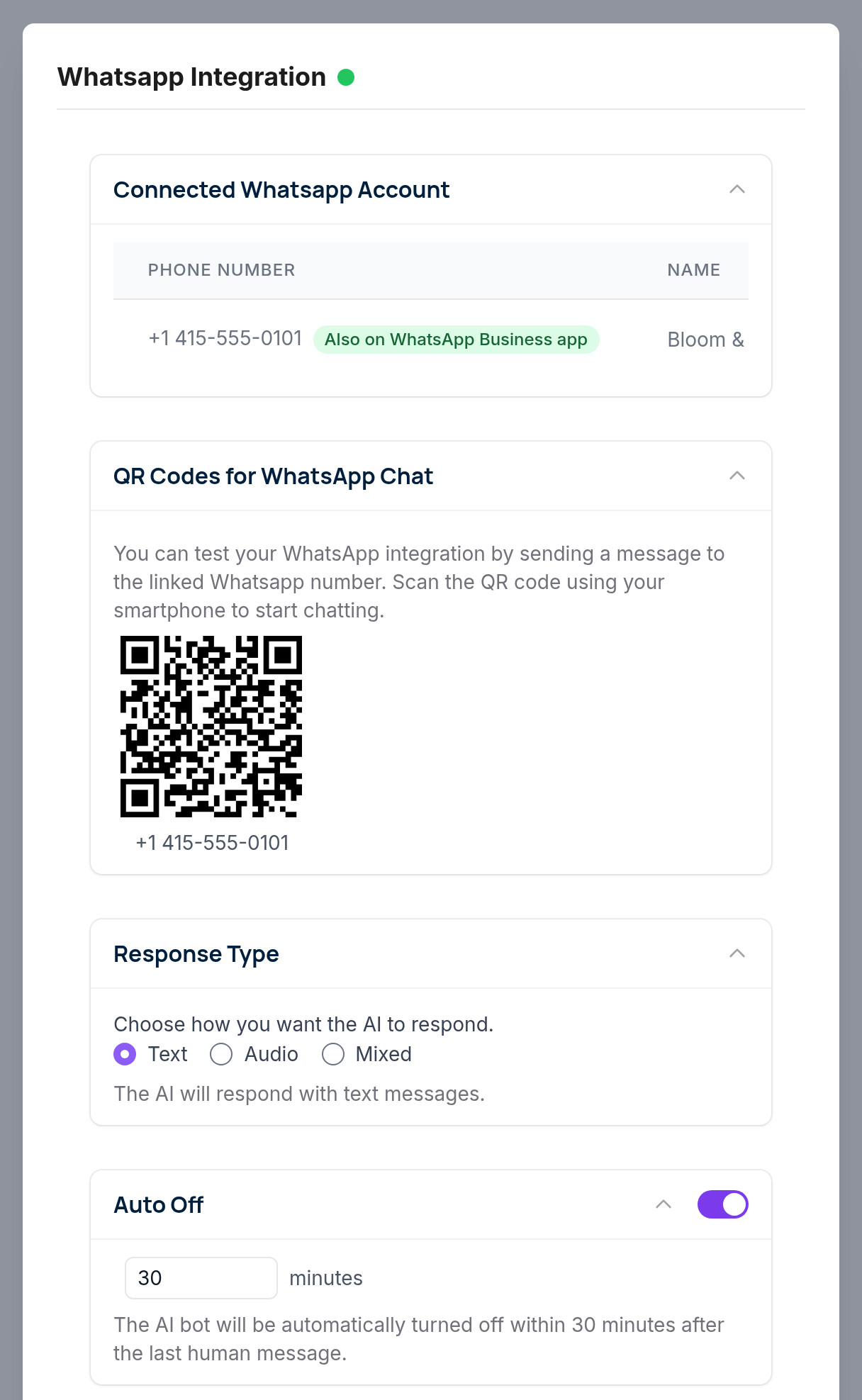
(Optional) To change your WhatsApp profile, such as its picture and description, click PHONE PROFILE at the right end of the number's row (scroll the table sideways if you don't see it). It opens Meta's WhatsApp Manager, where you make the change and click Save.
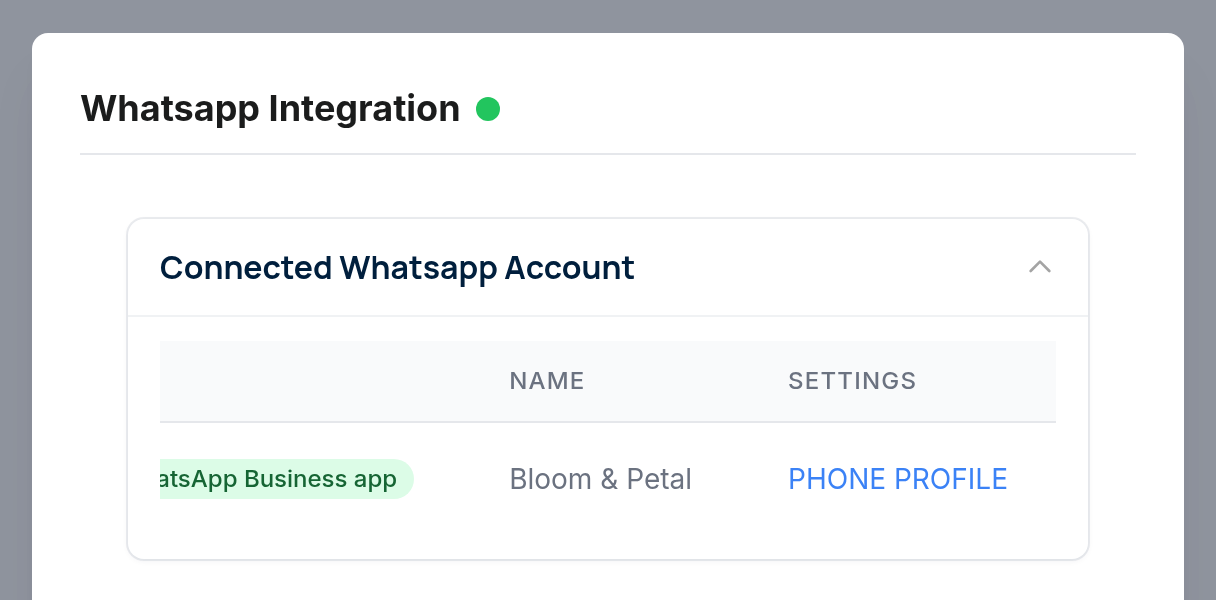
(Optional) Scan the QR code shown in the integration with your smartphone and send a message to test it. Your AI agent should reply. The customer's phone number is collected automatically as a lead. The video below shows such a test.
What WhatsApp charges
WhatsApp bills your WhatsApp Business account directly, not through Chat Data (see WhatsApp pricing, as of November 2026):
- Replies sent within 24 hours of a customer's last message: each number gets 1,000 free a month, then WhatsApp charges per message. Without a payment method, WhatsApp stops delivering replies after the free 1,000.
- Template messages, including campaigns, are charged per message by category and country.
Add a payment method in your Meta billing settings before you go live: without one, template messages and campaigns aren't delivered.
Connected without the app by mistake
If your number isn't marked Also on WhatsApp Business app in the integration, it was connected without the app. Your AI agent still answers, but you can only reply from Chat Data Live Chat, not from your phone. This almost always happens because:
- Create a new WhatsApp Business profile was chosen in step 7 instead of connecting the existing WhatsApp Business app, and the number was added as a new phone number. WhatsApp then said the number was already in use and asked to delete the WhatsApp account.
- The number was on the regular WhatsApp app, not WhatsApp Business, so Meta's window didn't offer to connect it. Move the number to the WhatsApp Business app first.
To put the number back on the WhatsApp Business app:
- Delete the number from your WhatsApp Business account in Meta: open WhatsApp Manager > Account tools > Phone numbers, select the number and delete it. Only an admin of your Meta business portfolio can do this, and WhatsApp doesn't allow it within 30 days of the number sending paid messages, such as templates. Until then, keep replying from Live Chat.
- In Chat Data, open Integrations > WhatsApp and click Disconnect. Disconnect on its own only stops Chat Data from using the number; it doesn't free the number at WhatsApp, which is why step 1 comes first.
- Register the number in the WhatsApp Business app (see Set up a new number in the WhatsApp Business app).
- Connect it again by following Connect WhatsApp with Chat Data. WhatsApp may ask for more activity in the app before it accepts the number.
If Meta's window says more activity in the WhatsApp Business app is needed, keep using the number in the app and try again in a few days. Don't delete your WhatsApp account to get past this message: that connects the number without the app.
Disconnecting
- To stop your AI agent answering, click the red Disconnect button at the bottom of the WhatsApp integration window in Chat Data (see the screenshot under Delayed Message Sending). Your number keeps working in the WhatsApp Business app.
- To also end the link at WhatsApp (otherwise Meta still treats the number as connected to the WhatsApp Business Platform), open the WhatsApp Business app and go to Settings > Account > Business Platform > Disconnect Account.
System User Access Token Signup Process
Occasionally Meta's signup window fails while verifying the phone number (a Meta-side issue). If that happens, you can connect with a system user access token instead. This path needs someone comfortable with Meta for Developers.
Try the signup again first
This path connects the number without the WhatsApp Business app. If the number is on the app today, you'd have to delete its WhatsApp account first, losing your phone chats, and you could no longer reply from your phone. To undo it later, you'd have to delete the number in Meta. If the signup window fails, try again later before using this path.
- Create a WhatsApp app following Meta's guidance.
- Add a phone number. In your app, open WhatsApp > API Setup and add your phone number, then verify it.
- Note the IDs. On the same API Setup page, copy the Phone number ID and the WhatsApp Business Account ID. Send a test message to the number to check it works.
- Generate a permanent access token. In Meta Business Settings > System users, add a system user (Admin), click Generate new token, choose your app, set the token to never expire, and select the
whatsapp_business_messagingandwhatsapp_business_managementpermissions. (The temporary token on the API Setup page expires within a day, so don't use it.) The video below shows these clicks.
- Add the number to Chat Data. In your chatbot's Integrations tab, open WhatsApp and select the System User Token tab. Enter the System User Access Token, the Display Phone Number, a Name, the Phone number ID and the WhatsApp Business Account ID, then click Connect. The status dot stays red until step 6; that's expected.
- Set the callback URL. In your app dashboard, open Configuration in the WhatsApp section of the left menu. Enter
https://www.chat-data.com/api/v1/chatbot/whatsapp/events/{chatbotId}as the Callback URL (replace{chatbotId}with your chatbot ID from Settings > General in Chat Data), enter any value as the verify token, and subscribe to themessagesfield. The status dot from step 5 turns green.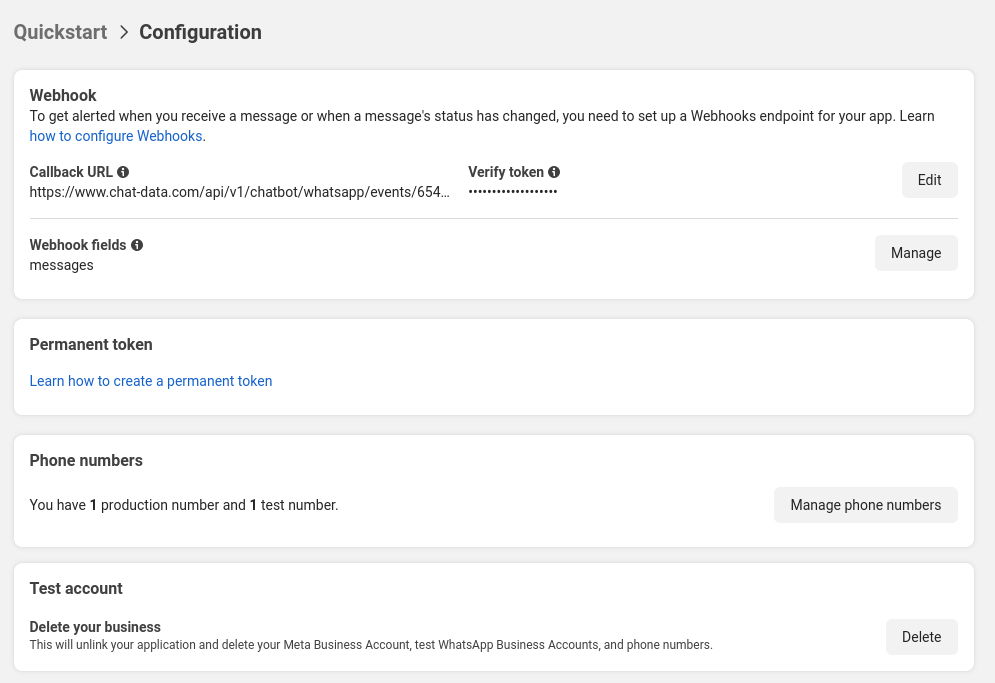
Delayed Message Sending
Customers often send a few short messages in a row. Turn on Delay Response in the WhatsApp integration window so the AI waits until they've finished and answers everything in one reply: each new message restarts the wait. Set the Average delay time and a Variance Range, both in seconds; the wait varies around the average by up to the variance so replies feel natural. A few seconds, such as 5 to 15, is usually enough. The in-app note about "this channel's message limit" refers to Enable Message Limit Per Thread below: once a customer reaches that many messages, the AI answers right away. The fields appear when you switch Delay Response on. Each setting in this window saves on its own: after you change it, click the check mark that appears next to it. The number list saves with the check mark in its Connected Whatsapp Account header; the Update button at the bottom reopens Meta's signup to add or reconnect numbers.
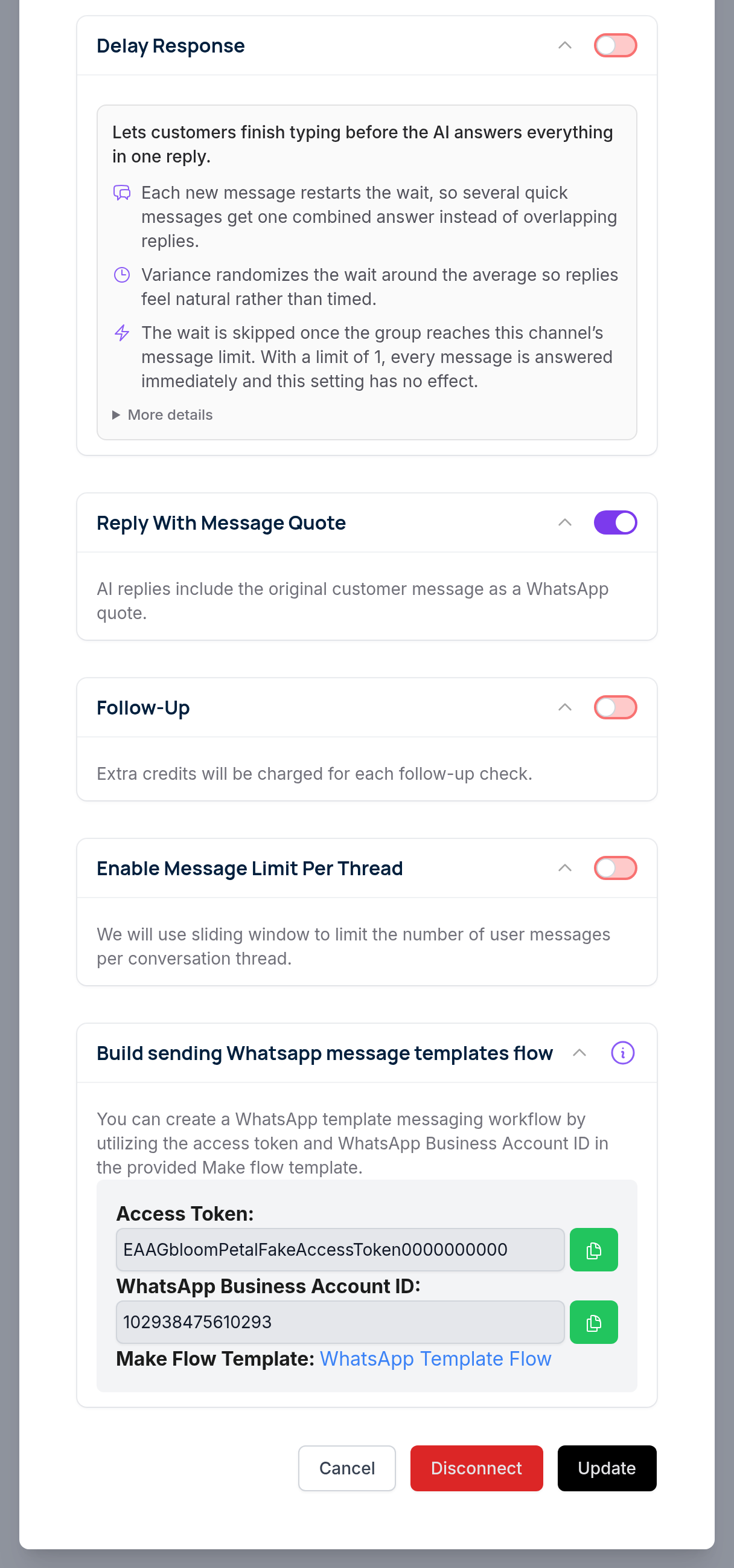
The window has a few more settings: Response Type (reply with text, audio or both), Reply With Message Quote (quote the customer's message in the AI's reply) and Enable Message Limit Per Thread (cap how many messages one conversation can send). The Build sending Whatsapp message templates flow box is the older way to send templates with Make; use Outbound instead.
AI Re-engagement
Timely follow-ups are crucial for ensuring customer satisfaction. If you want the AI chatbot to follow up with customers after their last interaction, turn on Follow-Up in the WhatsApp integration window (shown in the screenshot above) and click the check mark to save. Each follow-up check uses extra credits. Its fields:
- Follow Up Instruction: the style and content of the follow-up message.
- Trigger Condition: when a follow-up should be sent.
- Average delay time and Variance Range: how long to wait after the last message before checking, in seconds.
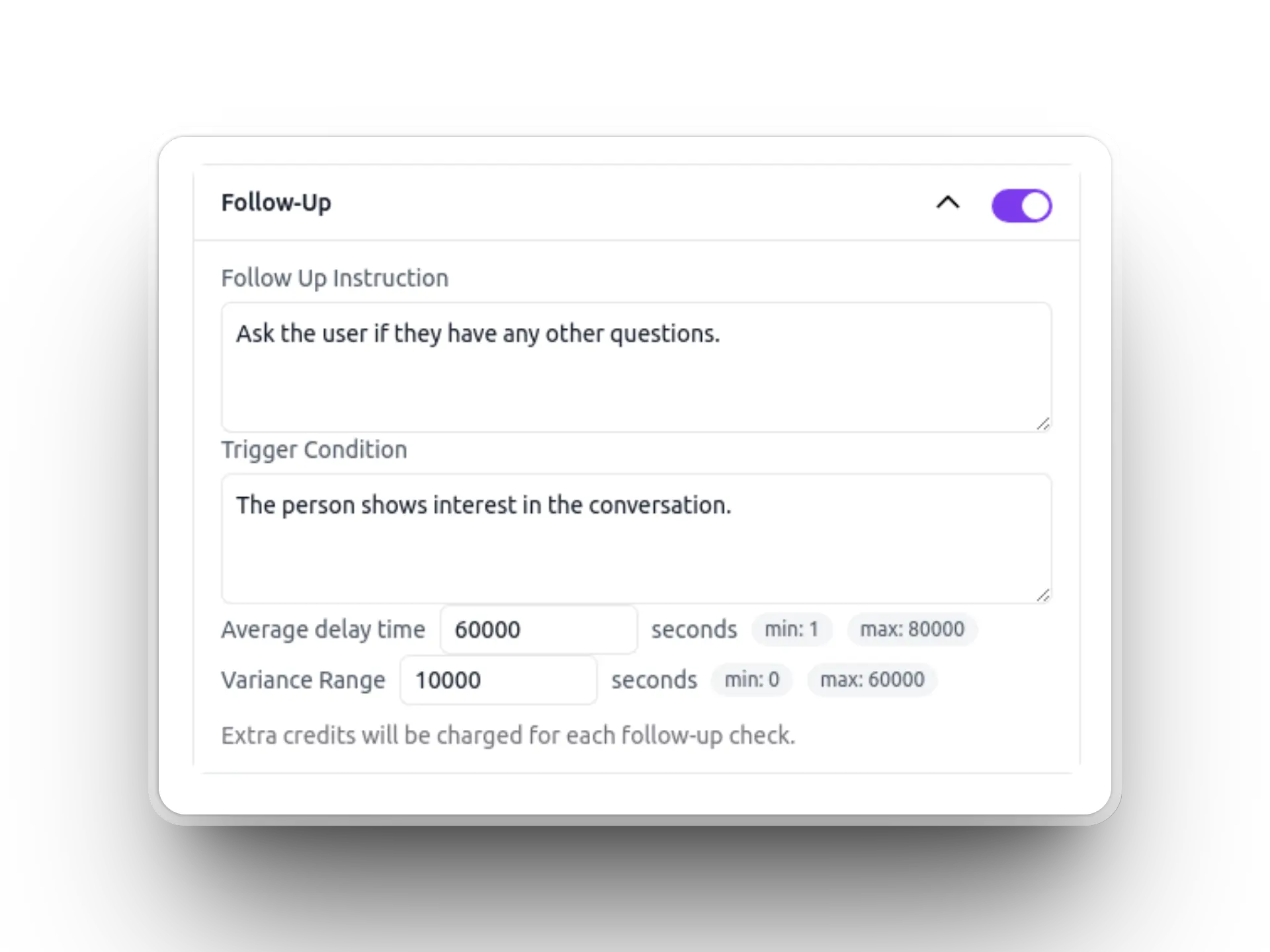
When the specified time arrives, the AI evaluates whether the conversation meets your defined re-engagement criteria. If the conditions are met, it sends a contextually appropriate follow-up message based on the previous conversation.
Live Chat Handover
When a customer needs a person, you can step in two ways:
- From your phone. Reply in the WhatsApp Business app as you always have. Your reply appears in Chat Data Live Chat and the conversation history, and Auto Off (on by default) keeps the AI silent in that conversation so it doesn't talk over you.
- From Chat Data Live Chat, on your computer, where your whole team can see and answer conversations.
(If your number was connected without the app, Live Chat is the only way to reply. See Connected without the app by mistake to fix that.)
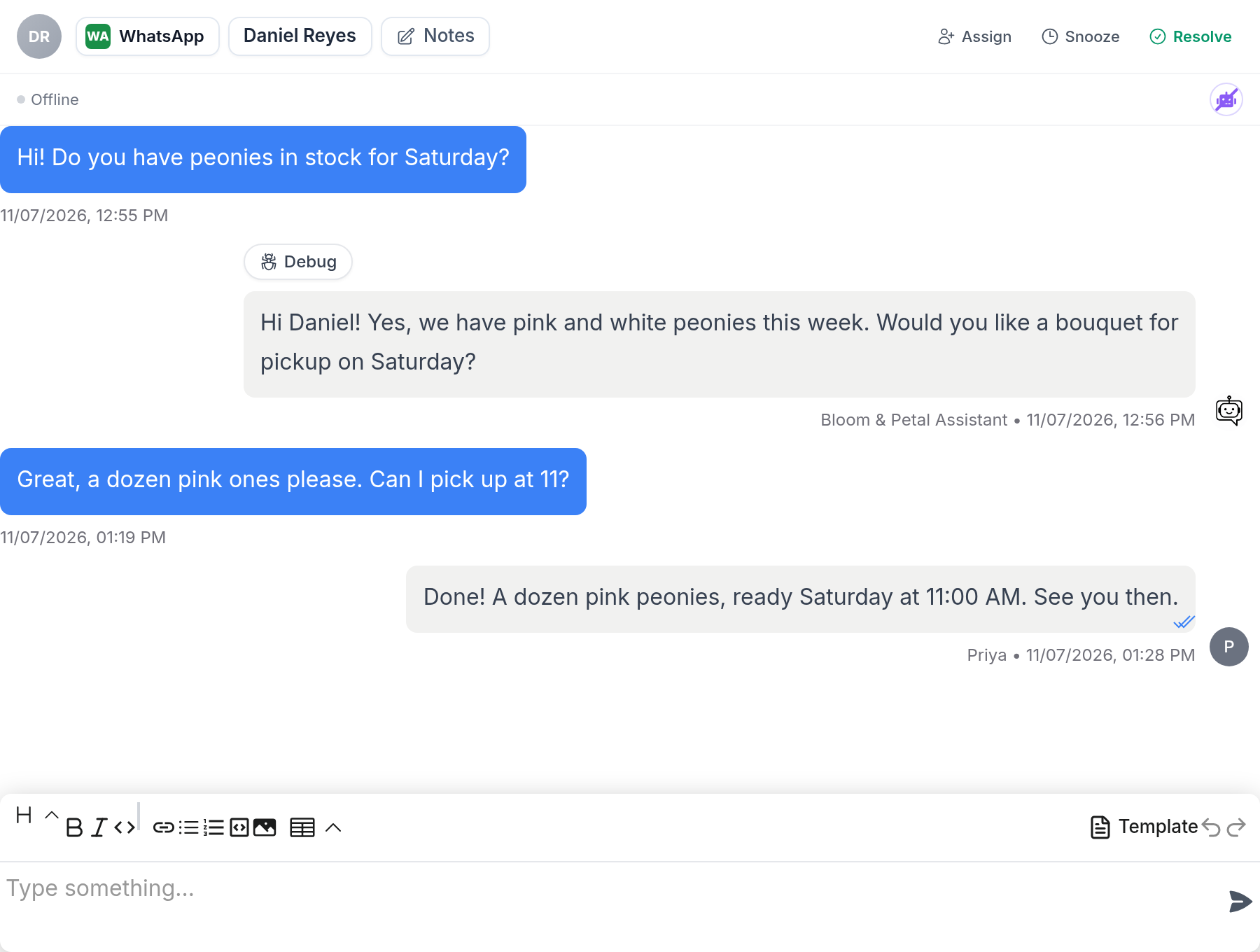
To reply from Chat Data, open Dashboard > Live Chats and select the WhatsApp conversation. To see only WhatsApp conversations, use the source filter and select WhatsApp.
You can also turn off the AI for a conversation by hand with the robot button at the top right of the conversation (a robot with a slash means the AI is off for this conversation; hover to see Bot ON or Bot OFF); it stays silent until you turn it back on. Without Auto Off or this switch, the AI would answer the customer's next message even while you are chatting with them.
Your reply is sent to the customer on WhatsApp. Live chat is off by default; turn it on in Settings > Live Chat so the Live Chats inbox updates as messages arrive and you get email alerts. With it off, conversations are still saved and Auto Off still pauses the AI, but the Live Chats inbox doesn't update in real time and you get no email alerts. If live chat is turned on and no agent is online when the customer writes back, you get an email with a link to the conversation.
You can switch the AI bot on at any time after you have finished the live chat with the customer.
Automatic AI chatbot pause (Auto Off)
Auto Off is on by default. When a person replies to a customer, from Live Chat or from the WhatsApp Business app, the AI stays silent in that conversation for the set time after the last human reply, then resumes on its own. The default is 30 minutes; you can set anything from 1 minute to one week (10080 minutes). (The setting's description, "turned off within 30 minutes after the last human message", means the AI is off during those 30 minutes.) While the AI is silent, customer messages wait for you in Live Chat, with the same email alert as above.
To change it, open Integrations > WhatsApp and find Auto Off in the integration settings (shown in the screenshot at step 13 of Connect WhatsApp with Chat Data). It applies to all your WhatsApp numbers. Enter the number of minutes and click the check mark that appears to save it. Switch it off if you never want the AI to pause on its own.
Reach customers first with WhatsApp templates
WhatsApp only lets you send a normal message within 24 hours of the customer's last message. After that, or to message someone first, you send a template: a message WhatsApp has approved in advance. WhatsApp charges for each template message.
Everything is under Outbound in your chatbot's left-hand menu (marked New; see the menu screenshot at step 1 of Connect WhatsApp with Chat Data). If your plan doesn't include it, the page shows which plans do (see pricing).
Marketing templates don't reach US numbers
WhatsApp doesn't deliver marketing templates (promotions, offers) to US numbers. Other +1 countries, such as Canada, still receive them, and utility templates, such as order or appointment updates, reach US numbers too. The examples below use a business with both US and Canadian customers.
| To... | Use |
|---|---|
| Message one customer | Send to one |
| Pick up a quiet conversation | Choose template in Live Chat |
| Message many customers | A campaign |
| Send from your own systems (or Make, Zapier, n8n) | The API |
Create a template
Templates are created and approved in WhatsApp Manager, Meta's site for your WhatsApp account (sign in with the same Facebook account you used to connect), then show up in Chat Data.
- Open WhatsApp Manager > Message templates and click Create template.
- Pick a category: Marketing (offers, news), Utility (order or appointment updates) or Authentication (login codes).
- Give it a name (lowercase letters, numbers and underscores, such as
spring_sale) and pick its language. - Write the message. Put
{{1}},{{2}}where each customer's details go, such as their name, and give WhatsApp a sample value for each. You can also add a header and buttons such as Shop now. - Submit it. WhatsApp reviews templates within 24 hours. If it's rejected, edit it in WhatsApp Manager and submit it again.
Approved templates appear in Outbound > Templates within 10 minutes. Click Refresh to see them right away, or WhatsApp Manager to open Meta's site. Authentication templates can only be sent through the API.
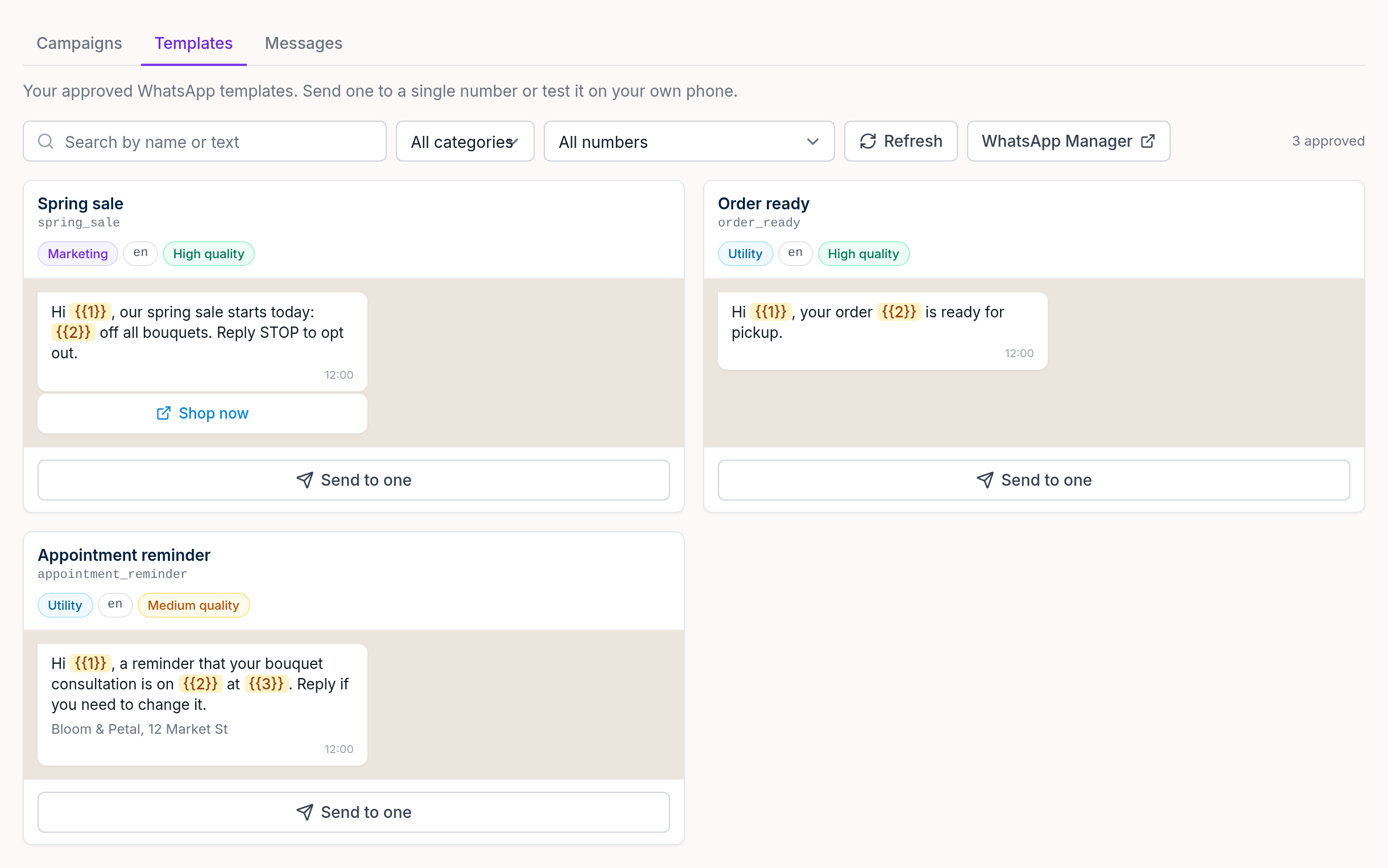
Send a template to one customer
- On a template, click Send to one.
- Choose the number to send From (if you have more than one), enter the customer's number with its country code under To, and fill in the variables. The preview shows exactly what they'll get.
- Click Send (the button reads Send test if you tick Send as a test).
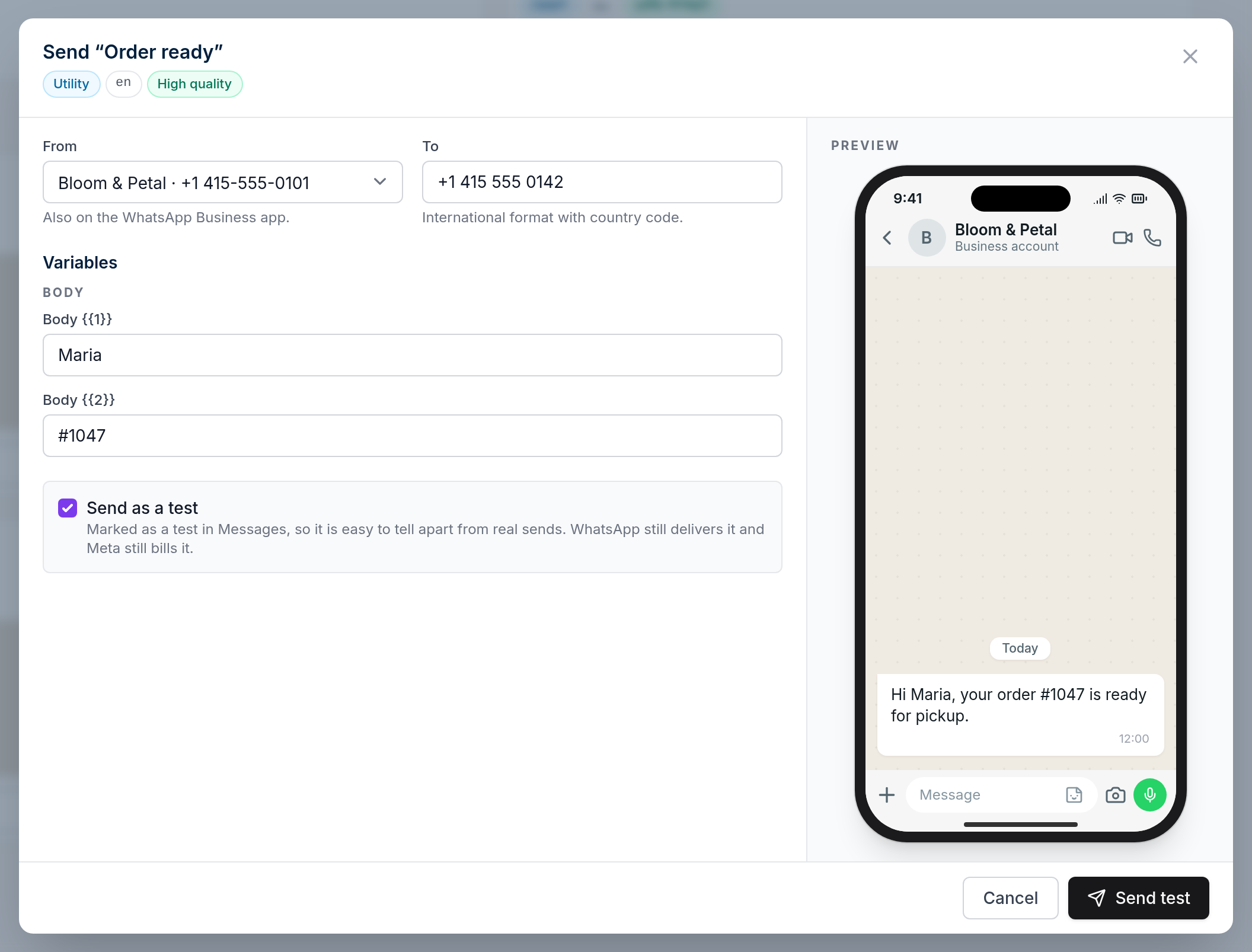
The message joins the customer's conversation, and your AI agent answers their reply as usual. Tick Send as a test to label it Test in the Messages tab; it's still a real message that WhatsApp charges for.
Reopen a conversation from Live Chat
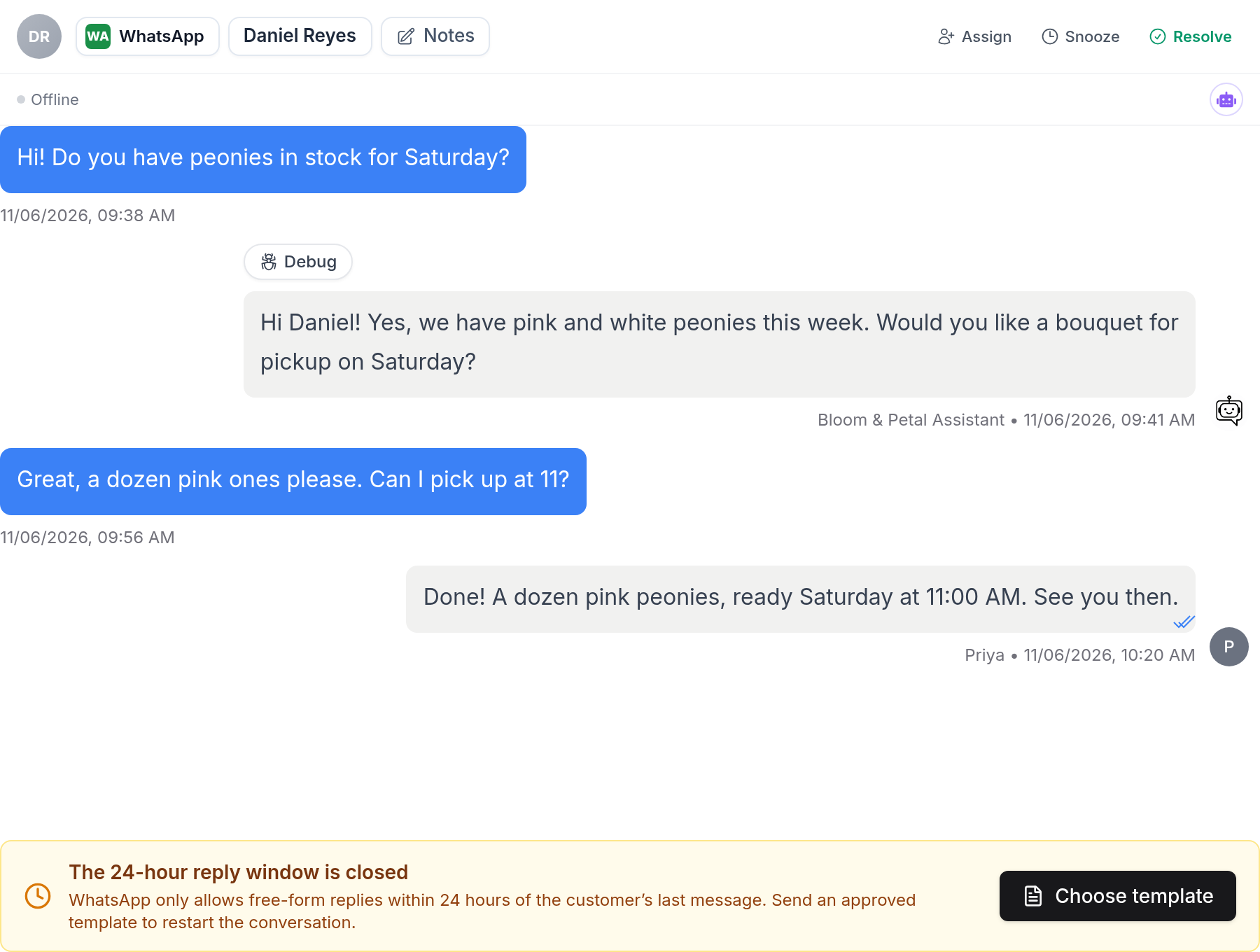
When a customer's last message is more than 24 hours old, Live Chat shows a banner instead of the message box. Click Choose template, fill in the variables (you can use the customer's lead details) and send. Once they reply, chat normally. Within the 24 hours, the Template button in the message box lets you send a template at any time.
Prepare your audience
Campaigns go to your leads, so bring your contacts in first. Only message people who agreed to hear from you on WhatsApp: WhatsApp requires it, and messages people didn't ask for lower your number's quality rating. In your chatbot's menu, open Dashboard > Leads Dashboard:
- Attributes: add your own fields, such as city or plan, to use in messages and audiences.
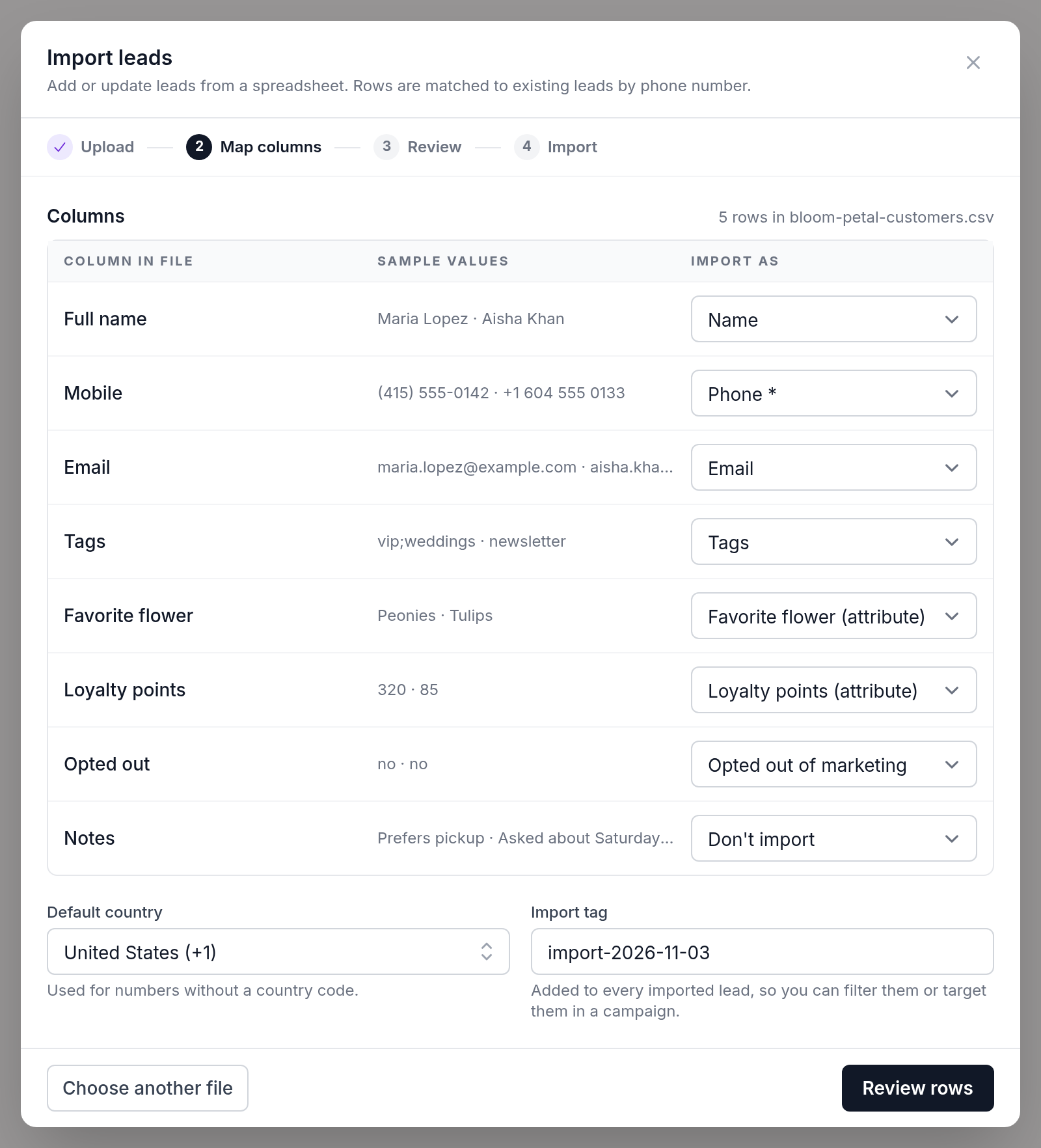
- Import: upload a CSV or Excel file, match your columns to lead fields, and pick the default country for numbers without a country code. Numbers that match an existing lead update it. An Opted out of marketing column marks customers who don't want promotions. Each import is tagged (for example import-2026-11-03) so you can target it in a campaign.
Opt-outs are automatic. Customers who reply STOP or UNSUBSCRIBE, tap Stop promotions, or turn off marketing messages in WhatsApp are left out of marketing campaigns but still get utility messages. You can also switch on Opted out of marketing in a lead's details.
Send a campaign
In the Campaigns tab, click New campaign. The campaign is one page; fill in each section from top to bottom:
Delivery: a name and the number to send from.
Content: the template, and where each variable comes from (a lead field, a custom attribute or fixed text). Add a fallback, such as "there" for a missing first name.
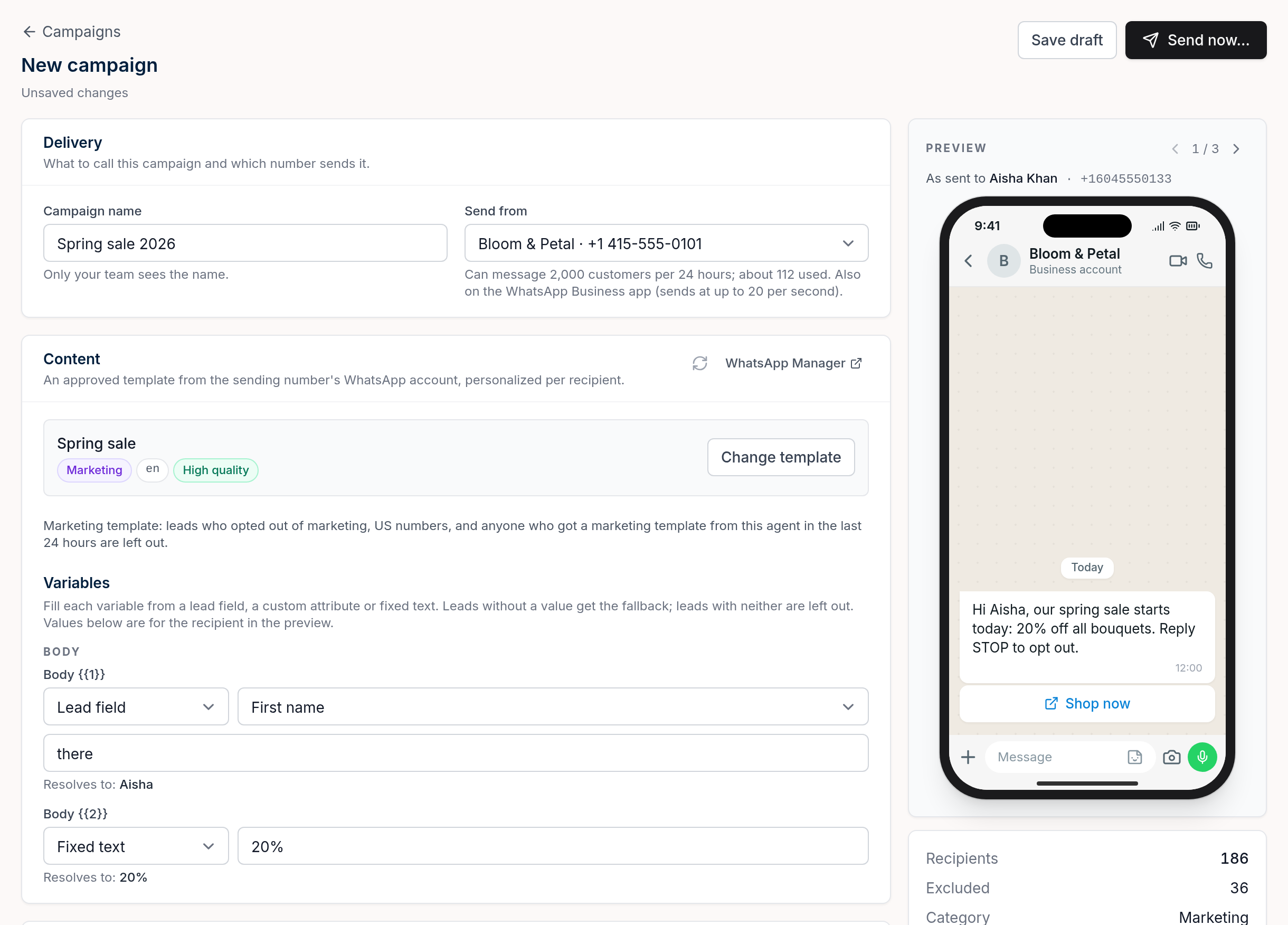
Replies: AI replies lets your AI agent answer; Live chat sends replies to your team and switches the AI off in that customer's conversation until your team turns it back on with the robot button.
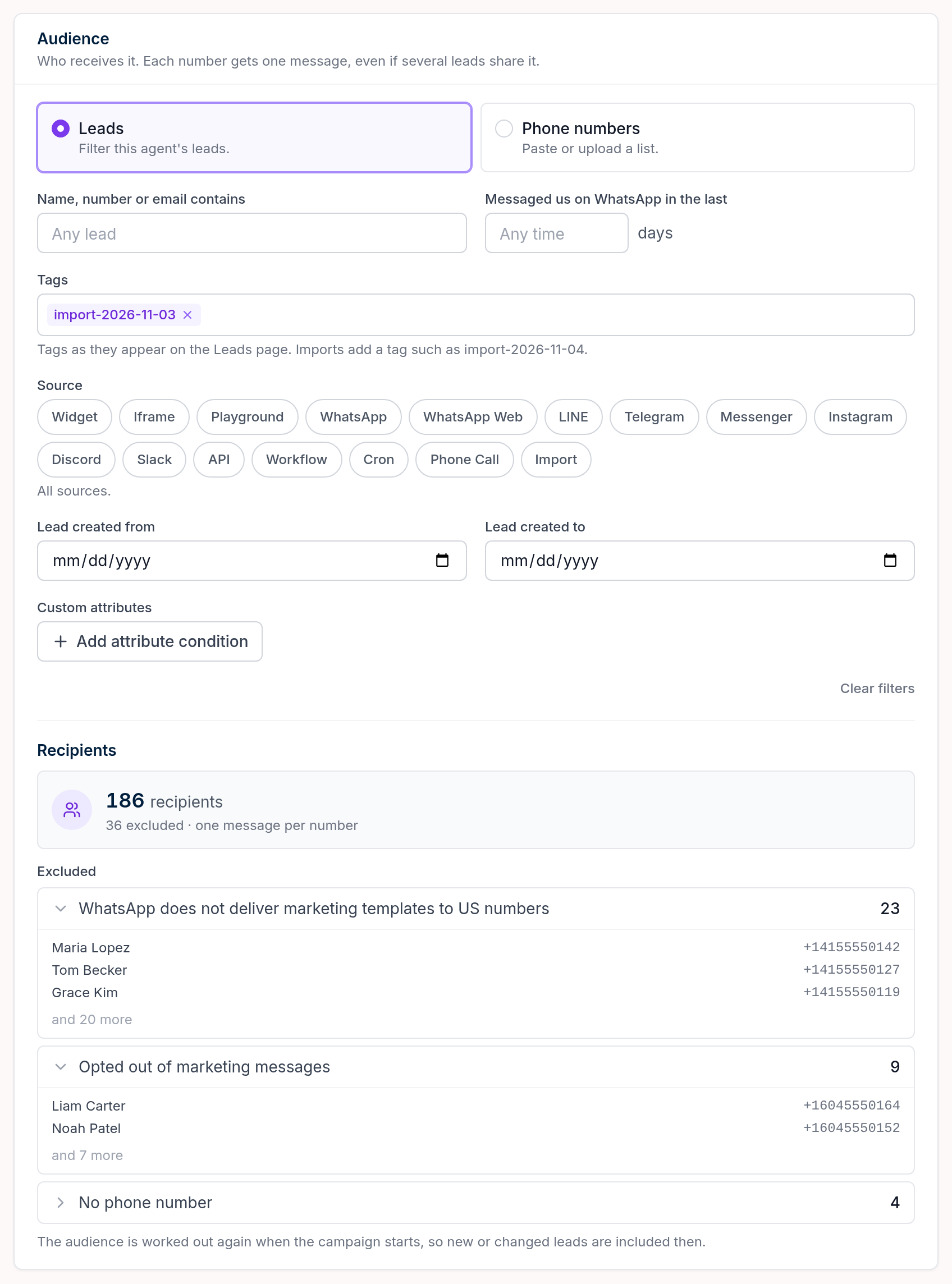
Audience: filter your leads (tags, source, attributes, recent activity) or paste a list of numbers. The preview shows who gets it and who is left out and why.
Schedule: send now or pick a date and time, then click Send now… (or Schedule…) at the top. Save draft keeps it for later.
Use Send a test at the bottom to see the message on your own phone first; tests don't count in the campaign.
Chat Data skips numbers it shouldn't message: invalid or blocked numbers, customers missing a variable with no fallback and, for marketing templates, opted-out customers, US numbers, and anyone who got a marketing template from this chatbot in the last 24 hours. Each number gets the campaign once.
Open a campaign to follow it: how many messages were delivered, read and replied to, each recipient's status, and Pause, Resume, Cancel campaign or Export CSV. The campaign's ID (used in webhooks and the API) is in its page address: …/outbound/campaigns/<campaign ID>. A campaign pauses on its own, with the reason shown, if WhatsApp stops your number or template from sending.
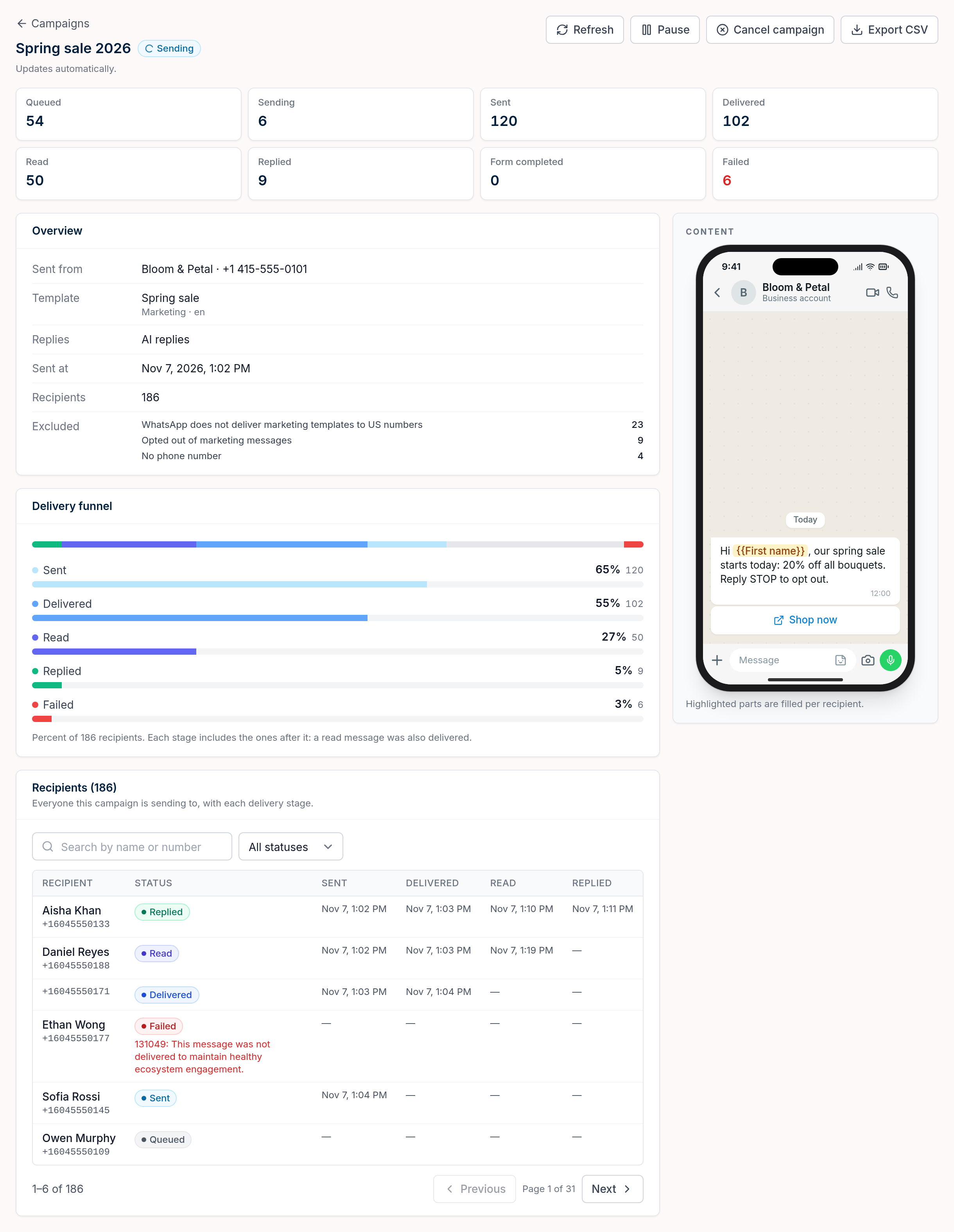
WhatsApp limits how many customers your business can start conversations with in 24 hours, shared by all numbers in your Meta business portfolio (some older Meta screens, like the one in step 12, still say "per phone number"). The limit grows as you send messages customers engage with. In the campaign, the number's current limit and roughly how many customers you messaged in the last 24 hours are shown under Send from. Chat Data doesn't hold recipients back for this limit, but it warns you when Recipients is more than the number can still reach in the next 24 hours; messages beyond the limit fail, so split the campaign or wait. New numbers start with a low limit, so start with a smaller audience.
Messages
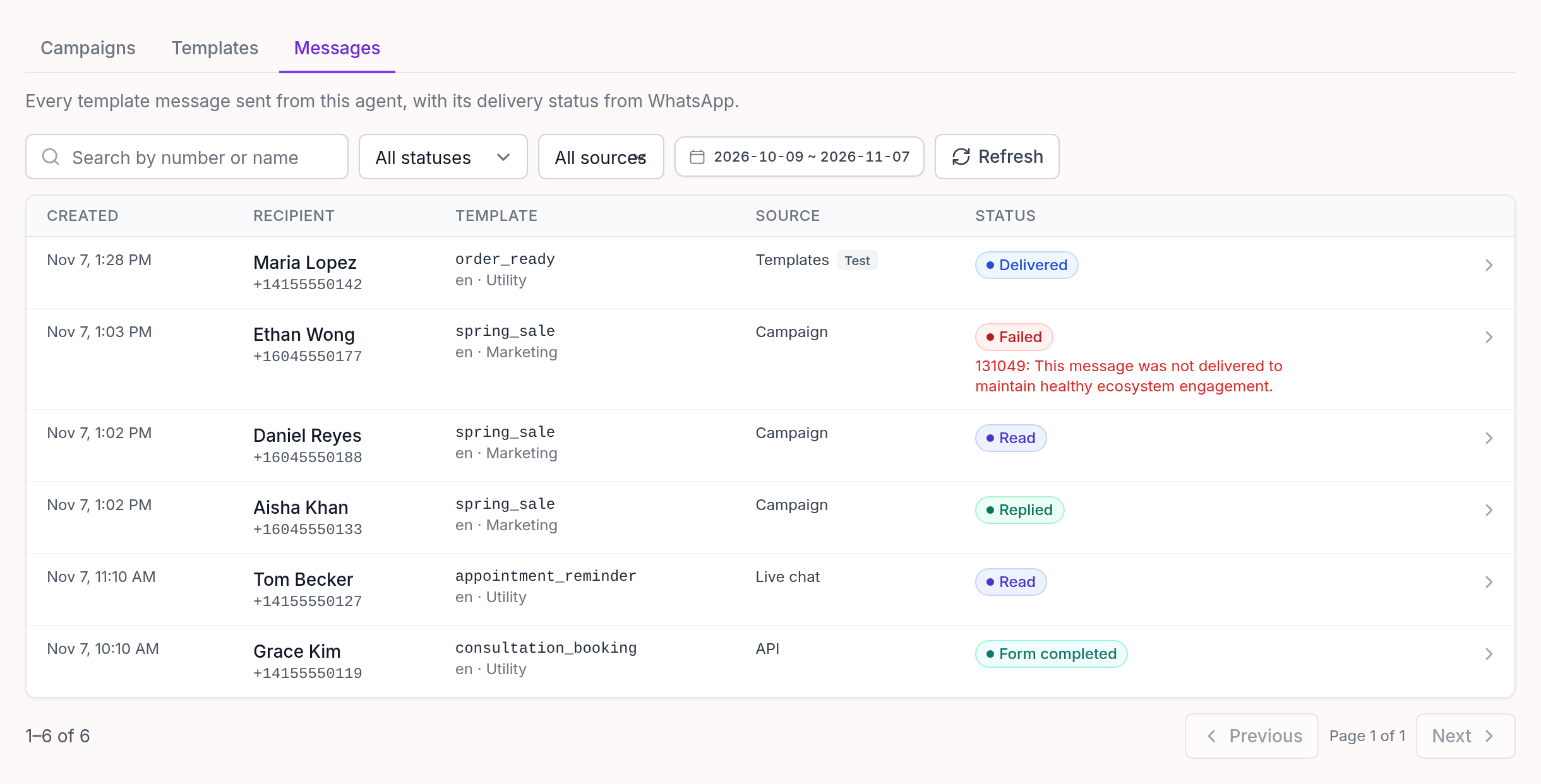
The Messages tab lists every template sent from this chatbot, from Outbound, Live Chat, campaigns or the API. Each one moves through Sent, Delivered, Read and Replied (or Form completed when the customer submits a WhatsApp Flow, a short form inside WhatsApp that you build in WhatsApp Manager). A Failed message shows WhatsApp's reason. The most common ones:
| Code | What it means | What to do |
|---|---|---|
| 131049 | WhatsApp limits how many marketing messages each person receives, and held this one back. | Wait at least 24 hours before sending it again, or send a utility template if it's about an order or appointment. |
| 131050 | The customer stopped marketing messages from you. | Nothing; they're left out of future marketing campaigns automatically. |
| 131026 | The message couldn't be delivered, for example the number isn't on WhatsApp. | Check the number. |
API and webhooks
Your own systems, or tools such as Make, Zapier or n8n, can list templates, send them, check their status and run campaigns through the Chat Data API. Subscribe a webhook to whatsapp-message-status and whatsapp-flow-response to get delivery updates and Flow answers. Customer replies arrive as chat events; replies you send from the WhatsApp Business app aren't sent as webhook events.
Frequently Asked Questions
Can I keep using the WhatsApp Business app after connecting my number to Chat Data?
Yes. Your AI agent answers customers on the number, and you can still reply from the WhatsApp Business app on your phone. Your phone replies appear in Chat Data live chat, and the AI pauses for that conversation when automatic AI pause is on. Some app features change, such as broadcast lists becoming read-only, and linked devices must be linked again.
How do I connect WhatsApp to a chatbot through the embedded signup flow?
Open the chatbot Integrations tab, select WhatsApp, click Connect, sign in with your personal Facebook account and choose or create your Meta business portfolio. Choose to connect your existing WhatsApp Business app, enter its number, scan the QR code with the app, confirm on your phone and click Finish. The number then shows Also on WhatsApp Business app in the integration.
Is there a fallback if Meta's embedded WhatsApp signup fails?
Yes. You can create the WhatsApp app yourself in Meta for Developers, generate a permanent system user access token, add the phone number, and set Chat Data's callback URL in the app. This path needs someone comfortable with Meta for Developers, and it connects the number without the WhatsApp Business app, so try the signup again first.
What does WhatsApp charge for messages?
WhatsApp bills your WhatsApp Business account directly, not through Chat Data. Each number gets 1,000 free replies a month within 24 hours of a customer's last message, and WhatsApp charges for replies after that. Template messages, including campaigns, are charged per message by category and country. Add a payment method in Meta billing settings so templates, and replies past the free 1,000, are delivered.